ROSALEE LECLERC had never lost a game of hide-and-seek, and she had never once won one fairly.
"…Twenty-nine. Thirty." She opened her eyes on an empty kitchen. "Ready or not, my loves."
Somewhere above her a door eased shut with the exaggerated care of a child who believes that quiet is the same thing as invisible. A giggle chased it — quick, swallowed, gone. Then the house folded its thirty rooms around John and Constance Markham and held its tongue.
Rosalee did not hurry. She wiped the flour from her hands, took the stub of white candle from her apron pocket, and touched it to the kitchen lamp.
"All right," she told the flame. "Show me where they've run to."
She cupped it close and thought about the twins — John's cowlick, the gap where Constance had lost a tooth in the spring — and she waited. The flame stood straight a moment, considering. Then it leaned. Not toward the draft off the open window, not toward the hall. It leaned east, toward the old wing, and held there steady as a pointing finger.
Her mother's voice came up out of the years, warm and dry as the bayou in August. You got the mojo, little one. Use it kind.
The east wing had been built and rebuilt by Markhams who could never leave a wall the way they found it, and it was honeycombed with the evidence: stairs that climbed to other stairs, passages tucked behind passages, doors painted to look like nothing at all. Rosalee passed three she might have searched, and didn't. The candle wanted the long gallery, where the afternoon came through in bars of gold and the portraits of children who would one day own all of this pretended not to watch her go by.
Halfway down it, she heard them — not a giggle this time but a shush, fierce and theatrical, and then the giggle anyway, leaking out from behind a panel of stained oak that showed no handle and no seam an ordinary eye could find.
She knew that panel. Behind it ran a spiral stair ribboned top to bottom with stained glass, the whole well of it alive with broken color, and it was the children's favorite place in all the house to be lost in. She had only to lay her palm flat against the wood and push.
She took a step toward it.
And the world fell over — or so it sounded. A great flat clatter went up from the far end of the gallery, metal on wood, loud enough to startle the portraits. Rosalee turned. Down where the afternoon pooled gold on the floorboards a saucepan lay rocking on its side, and above it a kitchen chair stood tipped at an angle no chair holds on its own, and trailing away from the chair, fine as a spider's first thread and catching the light only where it crossed the sun, ran a length of string. It went back along the baseboard, and back, and disappeared beneath the very panel she had been about to open.
She understood the whole machine of it in an instant. And she did the kindest thing she knew how to do.
She let it work.
"Mercy," she said, to no one in particular, and started off toward the fallen pan as though it were the most mysterious object in the world. "What in heaven was that?"
Behind her the panel banged open.
"YOU LOOKED!"
They came out of the wall like something fired from it, both at once, John in front and Constance a half-step behind and already correcting his trajectory, the two of them flushed and wild with the enormity of their success.
"You looked at the pan!" John shouted. "We pulled the string and the chair went over and the pan went BANG and you looked right at it!"
"I tied the knot," Constance said. "John held the end."
"We both held the end."
"You held the end. I tied the knot." Constance planted her hands on her hips, the architect declining to share credit with the labor. "It was a distraction."
"A diversion," said John.
Constance considered this, and allowed it. "A diversion."
"Father taught us the word." John said it again, slowly, the way you handle a thing too good to drop. "Di-ver-sion. You make a great big noise over there—" he flung an arm at the pan, "—so that nobody thinks to look over here." He laid the same hand on his own chest, in case the principle wanted illustrating. "And you didn't. You went straight for the pan."
Rosalee put her hand to her heart. The candle was in her pocket, and the candle had brought her to that panel in under a minute, and the two of them would never, ever know it.
"I went straight for the pan," she admitted. "I thought the whole house was coming down around my ears. I'd have hunted that saucepan till supper and never once thought to try the wall."
Constance glowed. John glowed brighter, being the one who had held the end of the string.
"Clever as a pair of cats, the both of you." Rosalee crossed to them and tugged Constance's braid, then offered John her hand to shake, gravely, the way he liked to be treated. "Too clever for one woman."
"It's the string that does it," John confided, leaning in. "You don't even have to be near the noise. That's the whole trick of a diversion."
"I'll bear it in mind," said Rosalee. "Now — who wants lemonade in the garden before the day gets away from us?"
"YES PLEASE," they said, in the one voice the two of them still shared.
• • •
She turned them loose on the garden and watched from the veranda with a sweating pitcher and three cups, and for a good while it was only an ordinary fine afternoon: the twins waging some war among the rose beds, the bees moving drunk and slow from bloom to bloom, the smell of cut grass and sun-warmed stone.
Then the bees stopped.
Rosalee noticed it the way a person notices a clock by the silence after it stops — the low drone that had filled the garden all afternoon simply was not there anymore. In the oak, a jay started up and broke off in the middle of its own complaint, as though a hand had closed over its beak. The breeze that had been worrying the wash on the line lay down and did not rise again. Beyond the wall, the whole forest stood there holding still.
The fine hairs lifted along her arms.
She did not decide to do anything. Her hand was already in her apron and the candle already out, and she struck the match against the rail without knowing she meant to. The flame caught. It stood straight—
—then bent flat toward the garden, toward the children, and went out.
No breath of air had touched it.
"John," she called, and heard the wrongness in her own voice. "Constance. Come up to me. Right now, please."
• • •
But the twins were not listening to the house. They were watching a rabbit.
It had come out onto the gravel path bold as a bishop, sat up on its haunches to take stock of the world, and looked at them. Not the way a rabbit looks at children — not the wide sideways flinch, the body already gathered to bolt. It looked at them straight on, with a kind of patience, the way you look at someone you have come a long way to fetch. Then it turned, went a little way down the path, stopped, and looked back, and waited.
"It wants us to follow it," whispered Constance.
"Then let's." John was already moving, because that was the order of things between them: he went first, and she went smarter.
The rabbit led them off the gravel and in among the boxwood, never hurrying, never quite near enough to touch, stopping each time they fell behind. Under the hedge the light came green and close, and the air smelled of mulch and cool dirt. The rabbit slipped through a gap in the roots ahead of them—
—and was gone, out the far side and away across the grass, as though it had only ever been a hand leading them by the sleeve, and had let go now that they were where they were meant to be.
For there, coiled in the shadow where the rabbit had been, was a thing that did not belong in any garden in Massachusetts.
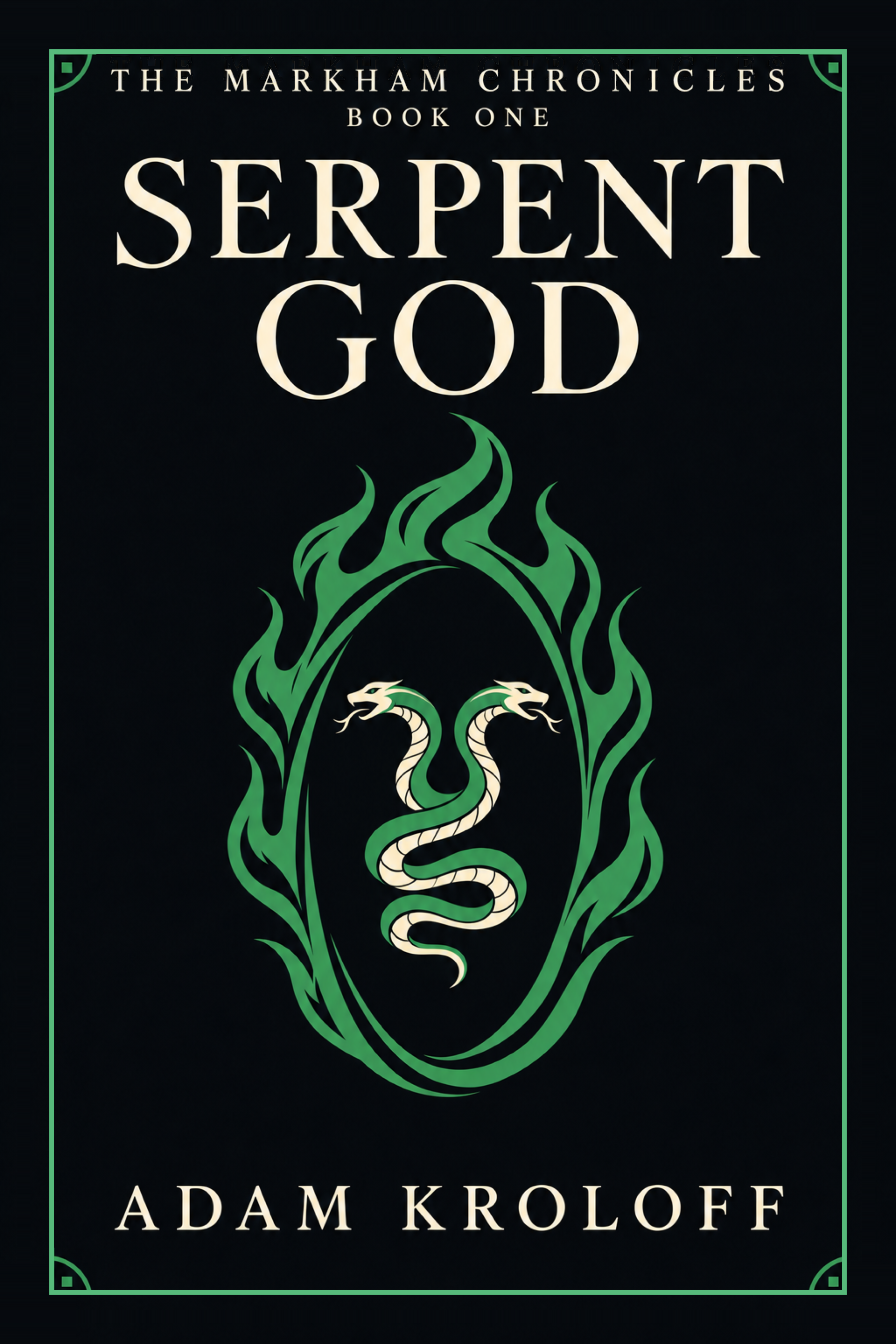
It was a snake, white as bone, and it had two heads.
Two slender necks rose from the one pale body and swayed, slow and out of step with each other, each ending in a blunt wedge of a head, each head set with a pair of small red eyes. All four eyes were on the children. There was nothing of the hunt in it — none of the coiled, waiting hunger of a thing about to feed. It regarded them the way the rabbit had regarded them: as something it had come for, an appointment long since fixed and now, at last, kept.
Neither child breathed.
It came on. Not quickly — it had no need to be quick — but unhurried, certain, pouring toward them over the roots like something that had crossed a very great distance to arrive at exactly this spot, and would not now be turned aside from it.
They should have run. That was the part Constance could never afterward explain — that they had only knelt there in the dirt while a white certainty flowed toward them over the roots, and that it had felt less like fear than like being expected.
Then it struck.
One head took John's left hand. The other took Constance's right. Two small pains, bright and precise.
And the garden went away.
There was no boxwood, no dirt, no Massachusetts — only the dark between the stars, and something coming through it. A serpent as long as a range of mountains and as broad across as a city, scale and sinew and storm, pouring through the void and trailing ruin behind it the way a comet trails its tail. Its face was every snake that had ever frightened anyone, all of them at once and none of them, a face older than the instinct to be afraid. Its fangs were spires. Its eyes were two eclipses, and behind the eyes there was no rage in it and no cruelty, only a purpose so vast and so old that it might cross the whole dark between the stars to reach a single garden and never once think the journey long.
Brightness came off the thing, though it lit nothing — a glare like a truth told too fast and too loud — and the children screamed in some place far beneath where screaming is done. And under the glare, around it and through it, a great many voices that were not human said a single word, over and over, the way a congregation lets out its amen.
Sah'ahsa.
• • •
The scream reached the veranda — both small voices at once, torn and high — and Rosalee did not take the steps. She put a hand on the rail and went over it.
She crossed the garden faster than she had moved since she was little, the dead candle still clenched in her fist, and found them at the boxwood, kneeling, swaying, their wet faces gone slack with a terror far too large for such small faces to carry. Blood beaded on their hands. She had them both up and against her before she had finished deciding to.
"I've got you," she said. "Rosalee's got you. I've got you."
She turned their hands over, bracing for the worst, and found very little: two clean punctures in the meat of John's left hand, two more in Constance's right. Already closing. No swelling. No black thread creeping up beneath the skin, none of the signs the bayou had taught her to dread before she was much older than they were now. As though the snake had never intended poison at all. As though all it had meant to leave behind was a mark.
Rosalee knew a snake bite when she saw one but the snake was gone.
John surfaced first. His eyes found hers and stretched wide. "It was a snake," he said. "It was white, and it had two heads—"
"I know, baby. I know. Hush now."
And as she held them, the garden quietly took itself back. The bees rose up out of nowhere and returned to their business. The jay finished the complaint it had abandoned. The breeze got up off the ground and stirred the wash again, and beyond the wall the forest went back to being only trees. To any eye but hers, nothing at all had happened on the Markham estate that afternoon, except that two children had been badly frightened by a snake.
Rosalee held them and did not believe a word of it.
It was Constance who finally spoke, cheek against Rosalee's shoulder, in the small flat voice she kept for arithmetic and serious things.
"Who is Sah'ahsa?"
The name went down Rosalee's spine like cold water. "Who, now?"
"Sah'ahsa," Constance said. "I heard it."
"I heard it too," said John.
Rosalee made herself smile, and made the smile reach her mouth, if no farther. "That was the snake hissing at you, child, nothing more. Snakes can't talk." She smoothed John's hair off his forehead. "A body hears all manner of things when it's scared."
"I s'pose so," John said, and his face cleared at once. He was five, and the world had just held a small door open for him out of a very large fear, and he was glad to step through it.
Constance said nothing.
She let herself be carried up to the house. She let herself be washed and fussed over and given her lemonade after all. But she kept her right hand shut the whole way, the two small marks pressed into the heel of her palm, and she did not believe that the thing in the dark had only been hissing. It had spoken a name, clear as a struck bell — and she could not shake the cold, certain feeling that it had wanted her, in particular, to hear it.